The AI Adoption Framework for Real Business Impact
From AI assistants and automation to intelligent agents and digital workforces, we design, deploy and scale AI solutions that improve productivity, automate processes and unlock measurable business value.
Most successful AI programmes begin with discovery and readiness before moving into deployment and scale.
Phase 1: Start Your AI Journey By Identifying High-Impact Opportunities
Every organisation contains processes that can be improved with AI, automation and intelligent agents. These services help you map, evaluate and prioritise where AI will deliver the greatest return.
AI & Automation
Discovery Workshop
A structured workshop designed to identify automation and AI opportunities across your organisation’s departments and workflows.
- Process mapping across departments
- Identification of repetitive tasks
- Prioritised AI use cases
- Implementation roadmap
Phase 1: Start Your AI Journey By Identifying High-Impact Opportunities
Every organisation contains processes that can be improved with AI, automation and intelligent agents. These services help you map, evaluate and prioritise where AI will deliver the greatest return.
AI & Automation
Discovery Workshop
A structured workshop designed to identify automation and AI opportunities across your organisation’s departments and workflows.
- Process mapping across departments
- Identification of repetitive tasks
- Prioritised AI use cases
- Implementation roadmap
Phase 2: Assess Your AI Readiness
Before deploying powerful AI tools, organisations must thoroughly understand their current capabilities and where AI can deliver the most significant value. Our AI Readiness assessment ensures the right foundations are firmly in place, and that your environment is secure for the safe and effective use of AI.
Our AI Readiness Framework: Four Core Pillars
Business, Strategy & People Readiness
We evaluate your strategic alignment and cultural preparedness for AI. Are teams truly committed, or just curious? Will employees actively embrace tools like Copilot?
M365 Technical & Infrastructure Readiness
This pillar assesses your technical environment, specifically your Microsoft 365 setup and broader IT infrastructure. Is the “plumbing” ready for AI tools to work reliably?
Data, Security & Governance Readiness
Data integrity and security are critical. We review data quality, access controls, and governance policies. If AI surfaces existing data, will it be handled safely?
Adoption, Change & Operating Model Readiness
We examine your organisational structure and change management strategies for sustained AI integration. Who will own AI initiatives, how will they operate, and will adoption truly stick?
Phase 3: Deploy AI Solutions
Once opportunities are identified, and the environement is secure, organisations begin implementing practical AI solutions. From AI assistants to intelligent automation, we deploy the right tools to the right problems — safely and effectively.
AI Assistants & Copilot Deployment
Deploy Microsoft Copilot the right way – from AI readiness and data governance through to a controlled pilot, company-wide rollout and ongoing optimisation. Our AI Starter Pack ensures your team adopts Copilot safely, confidently and as a genuine part of how they work every day.
- AI readiness, data governance & tenant cleanup
- 30-day controlled pilot before full rollout
- Adoption, training & workflow optimisation
- Security, governance & permissions management

-
Administrative Work:
Employees spend significant time writing emails, reports and documentation.
-
Information Overload:
Staff must review large volumes of documents and data.
-
Meeting Documentation:
Meeting notes and action summaries require manual effort.
-
Research & Analysis:
Employees spend time searching for information and summarising content.
-
Content Creation:
Teams must continuously produce new written material and communications.
-
Knowledge Access:
Finding answers across internal documents and systems can take time.
AI Assistants (Copilot / Chatgpt):

AI assistants support everyday work tasks across common business tools.
- Email drafting and communication
- Document writing and summarisation
- Meeting notes and action summaries
- Research summaries and insights
AI assistants help employees work more efficiently across departments.
- Faster report preparation
- Improved research productivity
- Faster analysis of documents and spreadsheets
AI assistants help employees find and summarise information quickly.
- Summarising internal documents
- Extracting insights from reports
- Answering knowledge queries
Microsoft Copilot Productivity Gains
Microsoft Copilot integrates AI directly into tools such as Outlook, Word, Excel and Teams to support everyday work tasks. Employees use Copilot to draft emails, summarise meetings, analyse spreadsheets and generate reports.
Results from early studies show: Up to 30–40% time savings on common productivity tasks AI assistants help organisations achieve immediate productivity gains while preparing for more advanced AI adoption.
AI Automation & Workflow Solutions
Automate repetitive processes across systems and departments, freeing your people to focus on higher-value work.
- Workflow automation
- Document processing automation
- Reporting automation
- System integrations
-
Manual Processes:
Many operational workflows still rely on manual tasks and data entry.
-
Disconnected Systems:
Business data is often spread across multiple applications and platforms.
-
Operational Reporting:
Teams spend time compiling reports and analysing spreadsheets.
-
Data Visibility:
Leaders struggle to access real-time insights across departments.
-
Process Bottlenecks
Approvals, document processing and manual reviews slow down operations.
-
Decision-Making Delays:
Important insights are often buried in data and difficult to access quickly.
AI Automation & Analytics:
Automation connects systems and removes repetitive manual tasks.
- Approval workflow automation
- Document and form processing
- Data synchronisation between systems
- Automated notifications and task routing
Analytics platforms transform operational data into actionable insights.
- Automated reporting dashboards
- Financial and operational performance analytics
- Customer and sales insights
- Real-time business intelligence
AI enhances automation by analysing data and supporting decision making within workflows.
- Invoice and document processing
- CRM and ERP data automation
- Lead and customer workflow automation
- Operational performance monitoring
DHL Supply Chain – Automated Operations Analytics
DHL Supply Chain operates hundreds of logistics sites worldwide and previously relied on teams manually compiling operational reports from warehouse, delivery and finance systems.
By introducing automated workflows and real-time analytics dashboards, operational data is now automatically consolidated and updated across the business.
Results include:
- 60–80% reduction in manual reporting time
- Operational dashboards updated in real time
- Faster identification of delivery delays and warehouse bottlenecks
- Improved decision making across logistics operations
Automation and analytics now allow leadership to monitor operational performance continuously rather than relying on manually compiled reports.
AI Agents & Intelligent Systems
Deploy AI agents that retrieve knowledge, automate tasks and support
decision-making across your organisation.
- Knowledge agents
- Customer service agents
- Service desk agents
- Operational insight agents
-
Repetitive Operational Tasks:
Teams spend time completing repetitive tasks across multiple systems.
-
Manual Ticket Handling:
Support teams must manually review, prioritise and route incoming requests.
-
Information Retrieval:
Employees spend time searching for knowledge across documents and systems.
-
Process Coordination:
Many business processes require manual coordination between teams.
-
Delayed Responses:
Customer or internal requests often wait for human availability.
-
Operational Inefficiency:
Important tasks are slowed down by manual processing.
AI Agents:
AI agents can complete operational tasks across business systems.
- Updating CRM records
- Retrieving and summarising business data
- Completing internal requests
- Executing defined operational workflows
AI agents can monitor requests, categorise issues and resolve common problems.
- Service desk support agents
- Customer service resolution agents
- Ticket classification and routing
- Automated issue troubleshooting
AI agents can retrieve knowledge and provide insights to support teams.
- Internal knowledge agents
- Data analysis and reporting agents
- Operational insights agents
- Compliance and policy agents
Enterprise Service Desk AI Agents
Many organisations are deploying AI agents within IT and service operations to automate ticket handling and knowledge retrieval. An AI service desk agent can:
- Monitor incoming support requests
- Categorise and prioritise tickets
- Resolve common technical issues
- Update systems and follow up with users
Results include:
Faster support response times and reduced service desk workload
AI agents allow organisations to scale operational capacity while enabling human teams to focus on more complex issues and strategic work.
Phase 4: Scale AI Across the Organisation
As organisations mature in their AI journey, they begin scaling automation and AI agents across operations. These services help you build enterprise-wide AI capability that grows with your business.
1
Agentic Workflows & Multi-Agent Systems
Coordinate multiple AI agents to automate end-to-end business processes, creating seamless intelligent operations across your entire organisation.
- Multi-agent orchestration
- Cross-system automation
- Intelligent process coordination
-
Complex Multi-Step Processes:
Many business operations involve multiple systems and teams.
-
Manual Process Coordination:
Staff must manually move tasks between departments or systems.
-
Fragmented Automation:
Individual automations exist but are not connected into a complete process.
-
Operational Delays:
Processes stall when waiting for manual input or decision making.
-
Data Silos:
Important information is spread across multiple platforms.
-
Scaling Operations:
Manual coordination makes it difficult to scale operations efficiently.
Agentic Workflows / Multi-Agent Systems:
Agentic workflows coordinate multiple AI agents to complete end-to-end processes.
- Customer request processing workflows
- Procurement and supplier management workflows
- Finance approval and reconciliation workflows
- Incident management workflows
Each agent within the workflow specialises in a specific role. Examples may include:
- Research agents retrieving information
- Analysis agents interpreting data
- Decision agents selecting actions
- Execution agents performing system updates
Agentic workflows can adapt dynamically as new information becomes available.
- Dynamic decision making within workflows
- Real-time process optimisation
- Automatic escalation or exception handling
- Continuous process improvement
AI-Driven Customer Support Workflow
A typical agentic workflow for customer support might include multiple specialised AI agents working together.
Example workflow:
Customer enquiry received ➡️ Support agent analyses the request ➡️ Knowledge agent retrieves relevant documentation ➡️ Resolution agent determines the appropriate solution ➡️ Execution agent updates systems and responds to the customer
Each agent performs a specific function within the workflow while sharing information to complete the overall process.
Results include:
Faster resolution times and the ability to automate complex support processes end-to-end
Agentic workflows enable organisations to automate multi-step operations that previously required coordination between several teams.
2
Digital Workforce Development
Deploy AI-powered digital workers that operate alongside human teams, scaling your operational capacity without scaling headcount.
- Operational automation
- AI-driven reporting
- Scalable digital workforce capabilities
-
Operational Capacity Constraints:
Businesses often struggle to scale operations without increasing headcount.
-
Repetitive Operational Work:
Large portions of work involve repetitive digital tasks such as data processing or reporting.
-
Process Delays:
Manual workflows slow down operations and create bottlenecks.
-
Human Error:
Manual data entry and repetitive processes increase the risk of errors.
-
Operational Cost Pressure:
Organisations must improve efficiency while controlling operational costs.
-
Scaling Customer and Operational Demand
Businesses must handle growing volumes of transactions, enquiries and data.
Digital Workforce:
Digital workers can execute operational workflows across enterprise systems.
- Processing invoices and financial transactions
- Updating CRM and operational systems
- Managing document processing workflows
- Performing routine data processing tasks
A digital workforce allows organisations to run large volumes of processes continuously.
- Customer service request handling
- Financial reconciliation and reporting
- Supply chain and procurement processing
- Operational data monitoring and analysis
Digital workforces are designed to work alongside human teams.
- AI handles repetitive operational tasks
- Humans focus on judgement, creativity and decision making
- AI systems surface insights and complete background processes
Enterprise Digital Workforce Automation
Many organisations are deploying digital workers to automate high-volume business processes across finance, operations and customer service.
Examples include:
- Automated invoice processing
- AI-driven customer support handling
- Automated compliance reporting
- Large-scale operational data processing
In some cases organisations have automated 70% of order-processing workflows, significantly reducing cycle times and improving operational efficiency.
A digital workforce allows organisations to scale operational capacity by combining AI agents, automation systems and analytics into a coordinated operating model.
Phase 5: Ongoing AI Leadership
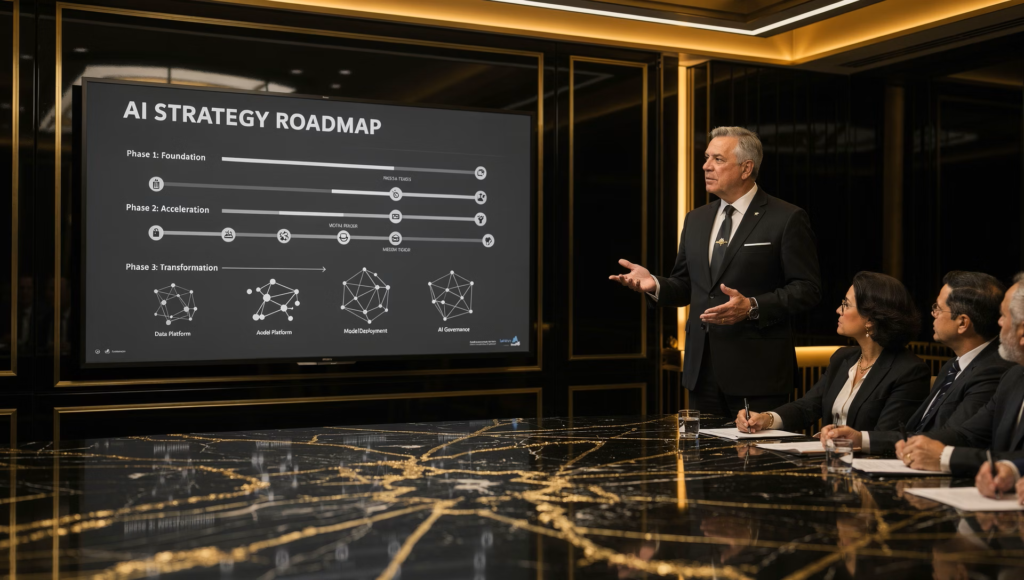
AI adoption is not just a technical challenge — it is a strategic one. Our advisory services provide the leadership, governance and long-term direction your organisation needs to succeed with AI at scale.
AI Advisory & Strategy
Strategic guidance to help organisations adopt AI safely and effectively, with a clear roadmap aligned to your business objectives.
- AI roadmap development
- Governance and compliance guidance
- Technology selection advice
- AI investment prioritisation

AI vCIO Service
Strategic AI leadership without hiring a full-time executive — access experienced AI leadership on demand to guide your programme.
- AI leadership guidance
- Governance and security oversight
- Innovation strategy
- Ongoing AI programme support
How We Approach Your AI Journey
Every successful AI programme follows a structured path – from initial discovery through to enterprise-wide scale. Here is how we guide organisations at every stage.
1
Discover
Identify high-impact AI opportunities and prioritise use cases based on ROI.
2
Assess
Evaluate AI readiness, governance, security and organisational capability.
3
Deploy
Implement AI assistants, automation and intelligent agents safely within existing systems.
4
Scale
Expand into agentic workflows, automation and digital workforce capabilities across the organisation.
Our structured approach ensures AI is adopted safely, practically and in alignment with your organisation’s goals — reducing risk and accelerating time to value at every stage.
Why Organisations Choose Us
We combine strategic AI expertise with real-world implementation experience — helping organisations adopt AI safely, securely and with measurable business impact.
1
Structured Methodology
A proven, repeatable approach that guides organisations from AI readiness and discovery through to deployment and scale.
2
Business-First Thinking
We focus on operational impact and measurable ROI, not technology for technology’s sake.
3
Responsible AI
Security, governance and responsible AI principles are embedded into every solution we deploy.
4
End-to-End Partnership
From strategy and readiness through to deployment and ongoing AI advisory — we support organisations at every stage of their AI journey.
As a Managed AI Provider, we combine cloud expertise, cybersecurity knowledge and AI implementation experience to help organisations adopt AI responsibly and at scale.
The Impact of Getting AI Adoption Right
Organisations that follow a structured approach to AI adoption consistently achieve faster results, higher adoption and greater operational impact than those experimenting with AI tools without a clear strategy.
1
Faster Deployment
Structured discovery and planning significantly reduces the time required to move from experimentation to production-ready AI solutions.
Typical organisations deploy their first working AI use case within 4–8weeks after completing readiness and discovery.
2
Task Automation
AI automation and intelligent agents can dramatically reduce time spent on repetitive administrative tasks.
Organisations typically see a 40–60% reduction in manual effort for targeted processes.
3
Time to First Value
When AI initiatives begin with clearly defined use cases, organisations can realise measurable value quickly.
Many organisations see productivity improvements within the first 30–60 days of deployment.
4
Adoption Rate
AI assistants paired with structured training, governance and leadership support achieve far higher adoption across teams.
Organisations commonly see 70–85% employee adoption when AI tools are introduced with the right guidance and use cases.
What our clients say
Ready to Explore AI for Your Organisation?
Every organisation’s AI journey starts in a different place. Some begin by exploring productivity tools such as Microsoft Copilot. Others are ready to automate processes, deploy AI agents or introduce intelligent workflows.
The challenge is knowing where AI will deliver the greatest impact first.
Our role is to help you identify the highest-value opportunities, ensure the right governance and security foundations are in place, and guide your organisation through a structured AI adoption journey.
So you achieve real operational improvements — not just AI experiments.